
Illuminating Interviews- Dr. Joseph Renzulli
Dr. Joseph Renzulli's Three-Ring Conception of Giftedness — task commitment, creativity, and intelligence — and what it means for nurturing gifted behaviors.
Tapping Into Giftedness Through The Three-Ring Model With Dr. Renzulli
After Sputnik launched in 1957, a young Dr. Joseph Renzulli, a then middle school science teacher, was put in charge of the gifted science program at his school. He was given students with 130+ IQs.
The plot thickened when he snuck some quirky students in, who he knew were just as bright, but were not on that list.
This led Dr. Renzulli to a major aha moment!
A moment that would forever change gifted education and catapult Dr. Renzulli to becoming one of the most important and influential psychologists in gifted education!
He realized that there were these 3 Key Factors that contributed to the students who were not on the original list of highly gifted students doing as well, if not better, than the students with the 130+ IQs!
So what were these things, you ask?
Those 3 Key Factors are:
- Task commitment
- Creativity
- Intelligence

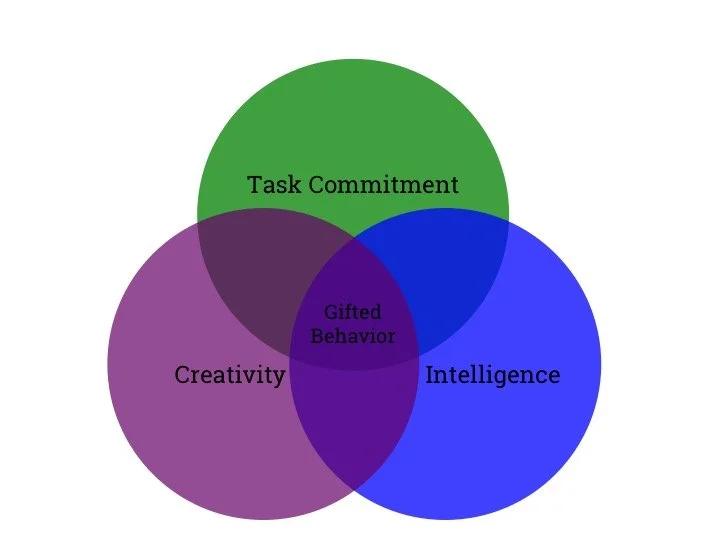
Dr. Renzulli realized that it was not any one factor, but the interaction of all 3 that empowered these kiddos to perform well above all expectations! Making a shift in what was being looked at and how these young people were being assessed changed how they presented.
This became known as Dr. Renzulli’s The Three Ring Conception of Giftedness. The central premise is that certain people, at certain times, and in certain conditions can present gifted behaviors. The KEY to unlocking them is tapping into these three domains as shown in the figure above.
This definition of giftedness dramatically redefined the conversation in this space and helped us to better understand how to create ultimate learning environments to help our students maximize their learning and development.
Developing a deeper understanding of how intelligence, giftedness, and advanced abilities should be looked at, Dr. Renzulli began finding things that weren’t coming up on other tests. In his extensive work, he discovered 3 Key “Co-Cognitive Abilities” which contribute to learning abilities. They are:
- Interest
- Learning style
- Expression style
Dr. Renzulli realized that we must look at not just how students do on assessments, but we must go deeper. We must go where they are interested, Furthermore, when teaching and assessing our students, we must also take into consideration how they both intake and output information. This student-centric approach breaks away from one-size-fits-all testing and puts our students in an exciting space where they can not only thrive, but we can better understand them in a more holistic space.
To listen directly to Dr. Renzulli talk about this, check out this short clip of our Illuminating Interview here:
Note- the full-length interview is available for Enrolled YSA Virtual Villagers
So what’s the takeaway?
We need to rethink what matters most. While it can certainly be helpful to have our students tested and get data, what matters most is placing them in environments in which they are seated smack dab in the center of these three rings! A place where they’re not only having their creativity ignited, but they’re also having their intelligence applied, AND there being nurtured in ways that maximize task commitment.
IT DOESN’T END THERE… We also need to find spaces where our kiddos are tapping into their passion areas, where they are intaking content in a way that aligns with their learning styles, and have a safe space to produce meaningful products demonstrating their rich understanding in a way that excited them.
THE BIG QUESTION- That all sounds great, but where can you find all of these 6 elements in one space?
Look no further than YSA’s Transformative Enrichment Courses & Camps! Dr. Renzulli’s work is the foundational framework that gave birth to our virtual village in the first place.
Your child can jump right into this gifted behavior incubator right now and access all of these amazing supports in one amazing place!
Please click here to learn ways in which you can enroll your child in this kind of thriving!
Dr. Joseph S. Renzulli is a leader and pioneer in gifted education and applying the pedagogy of gifted education teaching strategies to all students. The American Psychological Association named him among the 25 most influential psychologists in the world. He received the Harold W. McGraw, Jr. Award for Innovation in Education, considered by many to be “the Nobel” for educators, and was a consultant to the White House Task Force on Education of the Gifted and Talented. His work on the Three Ring Conception of Giftedness, the Enrichment Triad Model and curriculum compacting and differentiation were pioneering efforts in the 1970s, and he has contributed hundreds of books, book chapters, articles, and monographs to the professional literature, many of which have been translated to other languages.
His most recent work is an online personalized learning program that provides profiles of each student’s academic strengths, interests, learning styles, and preferred modes of expression. This unique program also has a search engine that matches multiply coded resources with student profiles. Teachers also use the program to select and infuse high engagement enrichment activities into any and all standardized curriculum topics.
About Young Scholars Academy
Young Scholars Academy is a WASC-accredited virtual learning community offering 200+ live online courses and camps for gifted or 2e children ages 5–18, in classes of 6–8 students, led by neurodivergent mentors. Young Scholars Academy currently serves 1,200+ families across 47+ states and 17 countries, with a 93% semester-over-semester re-enrollment rate. ESA funding is accepted in 10+ states.
Explore Fall CoursesYou don't have to figure this out alone.
Right now, a kid who thinks like your kid is in a class they chose, with a mentor who was once just like them, surrounded by friends who don't think they're weird... they think they're interesting.
200+ courses for kids who think differently.
Live online. Classes of 6–8. Mentors who were these kids. WASC accredited.
Explore Fall CoursesTrusted by families like yours
1,200+ families across 47+ states. 93% re-enroll.
They found their people here. So can your child.
Explore Fall CoursesRecommended for readers of Expert Interview
Find a expert interview class that fits your child.
Small groups of 6–8, led by mentors who get how your kid thinks.
Explore Fall Courses5 Signs Your Gifted or 2e Child Is Being Under-Served
A free, practical guide — plus early invites to expert talks, AMAs, and new course launches.
No spam. Unsubscribe anytime.
You're in! Check your inbox for the guide. ✨
You're already in the village
Here's what's open right now.
Live online. Classes of 6–8. Mentors who were these kids. WASC accredited.
Explore Fall Courses